
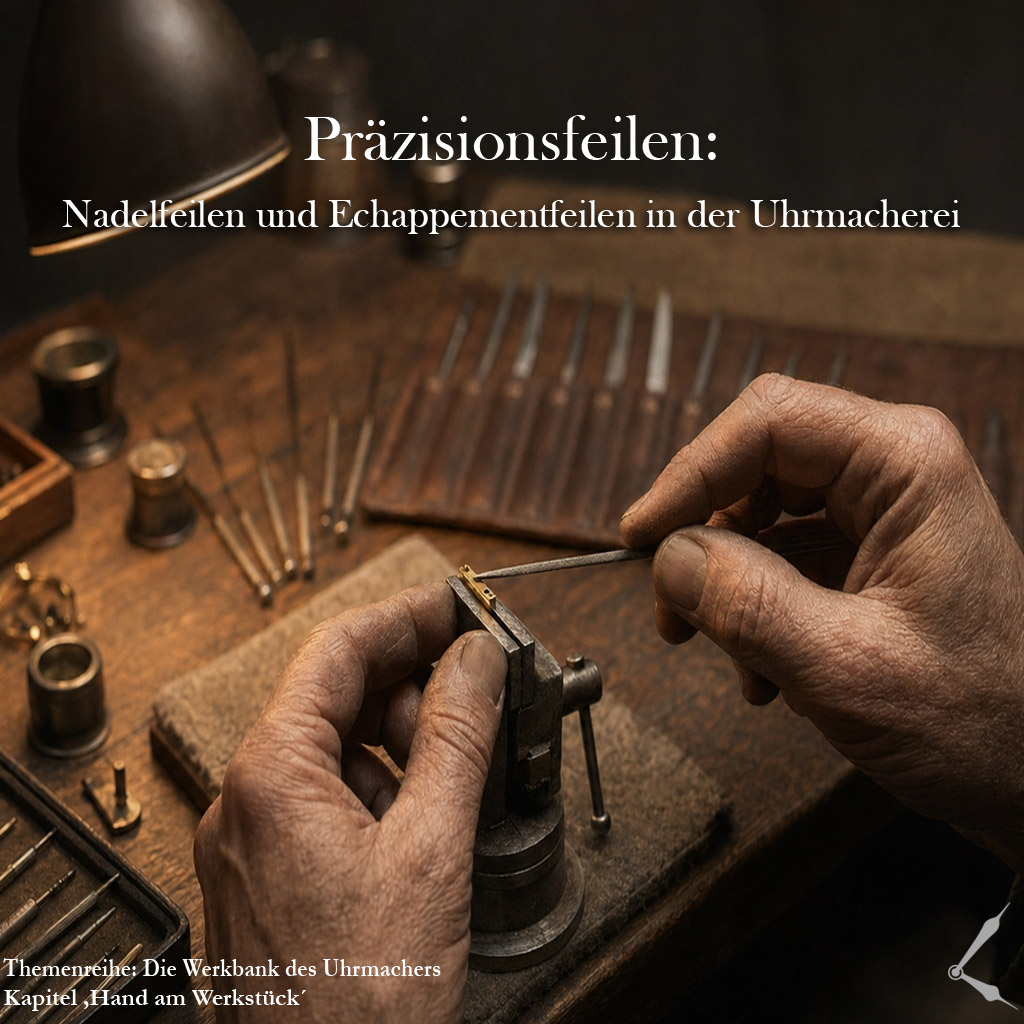
Precision Files: Needle Files and Escapement Files in Watchmaking
In the refined world of watchmaking, precision files are indispensable companions, used to rework delicate components with the utmost accuracy. While coarse workshop files handle rough material removal, needle files and escapement files open the way to masterful precision. Let’s explore their characteristics, the wisdom behind choosing them, and their historical roots.
Differences: Workshop Files vs. Precision Files
Workshop files, also known as bench files, have their roots in locksmithing and are excellent for fast, coarse material removal. They follow DIN standards with cuts 1 to 3 and are used mainly for rough shaping. Precision files, by contrast, define the world of watches, jewellery, and fine mechanics.
These files don’t follow uniform standards but rather manufacturer-specific ones, allowing for the finest of nuances. Their cut ranges from H00 (very coarse) to H4 (very fine), and occasionally even H8, for minimal shavings and exact contours. Note: the German cut differs from the Swiss one, which is why an H3 file can vary noticeably depending on its origin.
Needle files occupy the mid-size class, with a round, blunt end for use without a handle, while escapement files are the smallest specialists, designed for watch-specific fine work.
Cut, Cross-Section Shapes, and Tip Variants
The cut, measured as the number of cuts per centimetre of file length, defines the fineness: H00 for coarse preliminary work, H4 for very fine filing work. Valtitan files from Vallorbe Swiss withstand up to 72 HRC (Rockwell hardness), while conventional ones reach 60 HRC.
Cross-sections include rectangular-flat, triangular, square, round, half-round, bird’s tongue, barrette, and knife. Flat blunt files smooth level surfaces, flat pointed ones reach into tight recesses; bird’s tongue files shape curves, barrette files shape sharp corners.
The standard material, tool steel, dominates, complemented by diamond coatings for extreme hardness. The size range spans from solid bench files, through mid-sized needle files, down to the smallest escapement files.
The Historical Origin of Escapement Files
During industrialisation, factories supplied only raw movements (ébauches), which watchmakers then completed — often including the escapement parts on the pallet fork. This is where escapement files originated, named after the French “échappement”, meaning escapement.
“Filing work on the pallet fork required correspondingly small files.”
These tiny tools made fine craftsmanship possible without machines, and they remain essential in restoration work, where absolute millimetre precision matters.
Practical Selection: Material and Workpiece
The right file is of little use if it doesn’t match the material being worked and the shape of the workpiece exactly. For this, watchmakers follow clear basic rules:
The choice depends on the material: separate sets for brass and steel — the latter keeps the teeth sharp for longer — or mark the front and back by scoring. Brass shavings dull files more quickly.
Choose according to the workpiece:
- Flat blunt file for level surfaces such as a 20 x 20 mm cube.
- Bird’s tongue file for curves.
- Barrette file for corners on gear blanks.
- Triangular file for internal squares on the ratchet wheel.
- Needle files for smaller components.
- Escapement files for filing work on the escapement.
Always match the size so the file and workpiece suit one another. In watchmaking, precision always comes first.
Safety and Handling of Precision Files
Every file consists of the hardened blade with its cut, and the annealed tang, which carries a risk of breaking. With the pointed tangs of bench, needle, or escapement files, a secure handle is essential — firmly seated, to prevent injury.
Needle files with a round end can be used without a handle. Always check the handle and grip!
Keeping brass and steel files separate extends the lifespan of these tools.
Craftsman’s Conclusion
Precision files such as needle files and escapement files are at the heart of watchmaking mastery. They transform raw shapes into lasting precision and honour the traditional craft.
Coming up: in our next post, we turn to specialist files for restoration: from diamond files to swaging files.